Power quality and intelligent control of reactive power with BESS
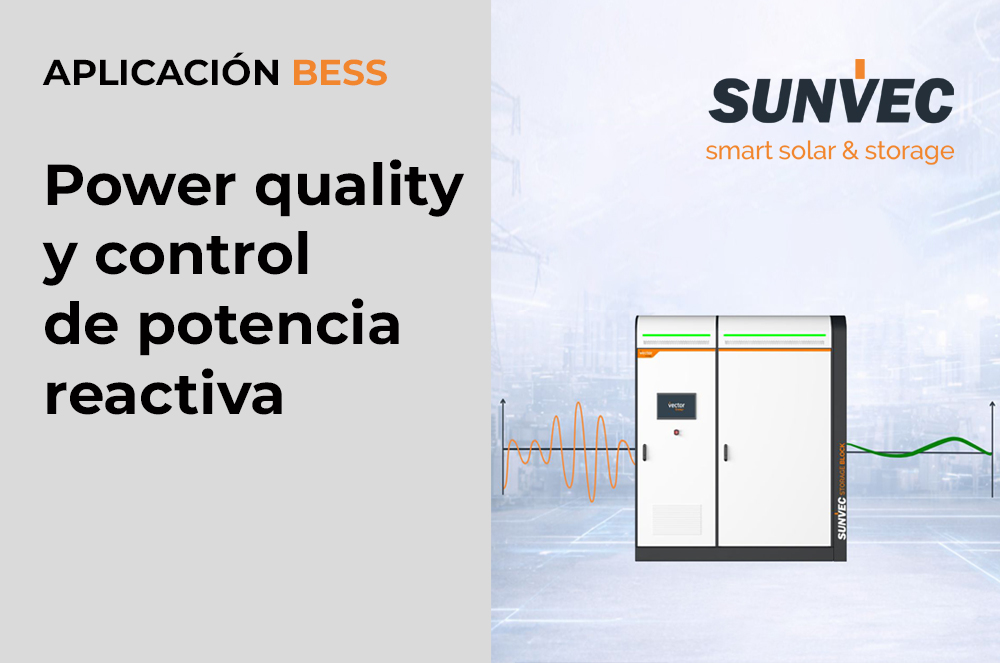
The quality of electrical energy directly influences the reliability and efficiency of an installation. Variations in voltage, rapid load changes, imbalances, or inadequate reactive power consumption can lead to penalties, losses, overheating, or poor performance of certain equipment. A BESS equipped with power electronics and a suitable control system can contribute to improving the power quality of an industrial or commercial installation.
The key element is the bidirectional power converter. In addition to charging and discharging the batteries, it can regulate certain electrical variables very quickly, always within its technical capabilities and the project configuration.
What is reactive power?
Motors, transformers, and other inductive loads need reactive power to generate magnetic fields. Although this energy is not directly converted into useful work, it circulates through the installation, takes up capacity in cables and transformers, and can worsen the power factor.
Traditionally, it is compensated by capacitor banks. A BESS with a compatible PCS can dynamically provide or absorb reactive power. The control adjusts the response according to the connection point measurements, allowing it to adapt to varying loads more precisely.
Functions that the BESS can provide
· Regulation of the power factor: The system can adjust the reactive power exchanged with the grid.
· Tension support: The controlled injection or absorption of reagent can help maintain the pressure within the expected limits.
· Dynamic response: The power electronics acts quickly in response to load variations.
· Enhanced active power: The battery can compensate for sudden changes in generation or consumption.
· Centralized supervision: The EMS registers electrical variables and coordinates the commands with other energy functions.
Benefits for the customer
Proper management can reduce unnecessary reactive current flow, free up capacity in the infrastructure, and avoid certain costs associated with a poor power factor. It also helps stabilize the electrical behavior of installations with sensitive machinery, large motors, distributed generation, or vehicle charging.
The BESS can perform some of these functions even without exchanging much active energy, although the apparent power available from the converter sets the limit. If the equipment is delivering all its active power, there may be less room for reactive regulation. The design must take these priorities into account.
A solution that requires engineering
Before defining the strategy, it is necessary to measure the installation, identify the source of the disturbances and check the connection requirements. The sizing of the PCS, the location of the analyzers and coordination with existing capacitors, filters or protections are essential factors.
At Vector Energy, we integrate storage, power electronics, and control to adapt the BESS’s response to the actual needs of each customer. A properly designed solution can combine energy savings, flexibility, and power support, improving the overall utilization of the infrastructure.
Learn more: sunvec.es/storage
















 Articles