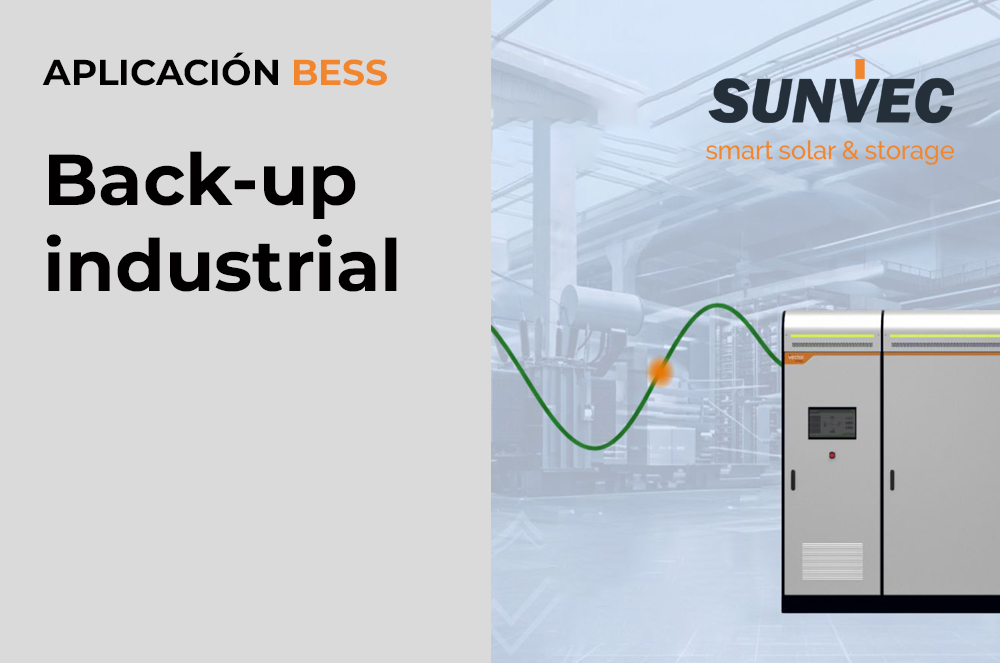
Industrial support with BESS: energy continuity and resilience through backup
An interruption in the power supply can stop production lines, affect computer systems, damage in-process products, or leave essential facilities offline. In sectors where every minute of downtime costs a significant amount of money, energy continuity becomes a priority. A BESS with backup capacity can provide power during an incident and increase the resilience of the company.
The support consists of isolating the installation from the network completely or partially when a fault occurs and feeding the selected loads from the batteries. To do this safely, the system must detect the incident, execute the switchover, monitor the internal network and coordinate with the protections and, when available, with photovoltaic generation or generators.
Which charges should be maintained?
It is not always necessary to back up the entire factory. The design usually begins with a classification of critical loads: control systems, servers, communications, emergency lighting, refrigeration cameras, pumps, processes that require a controlled shutdown, or equipment whose disconnection would cause damage.
This prioritization reduces the power and energy required and allows for greater autonomy for essential processes. A load management system can disconnect secondary loads and reconnect them progressively when the network recovers.
Benefits of backup with batteries
· Continuity of critical processes: the selected teams remain operational during micro-interruptions or longer interruptions.
· Reduction in the cost of stops: It helps to avoid production losses, complex restarts and material deterioration.
· Quick response: Power electronics can intervene in very short timeframes, depending on the system architecture.
· Greater resilience: the company has a local energy resource in the event of grid failures.
· Integration with photovoltaics and generators: The BESS can stabilize a microgrid and coordinate different sources.
· Daily use asset: Outside of emergencies, the battery can be used for self-consumption, peak reduction, or arbitrage.
BESS, SAI and generator set
These technologies are not always interchangeable. A UPS is designed to protect sensitive loads with defined continuity and quality; an electric generator can provide extended autonomy if it has fuel; and a BESS offers rapid response, silent operation, and multiple energy uses. In many projects, the most robust solution combines several systems.
For a BESS to work on an island, it must have the appropriate architecture, converter and protections. Not all equipment capable of storing energy can form an independent network. The starting currents of motors, the selectivity of protections, the earthing and the transition between modes must also be studied.
Autonomy and availability
Autonomy depends on the useful energy of the battery and the power of the supported loads. In addition, the EMS must maintain a sufficient reserve: a battery that has been discharged for economic reasons cannot fully respond to an unexpected power outage.
At Vector Energy, we analyze critical processes and design BESS solutions oriented towards operational continuity. The combination of storage, control, and a well-defined backup strategy allows us to reduce risks and prepare the installation to respond more safely in the event of supply disruptions.
Learn more: sunvec.es/storage





 Articles