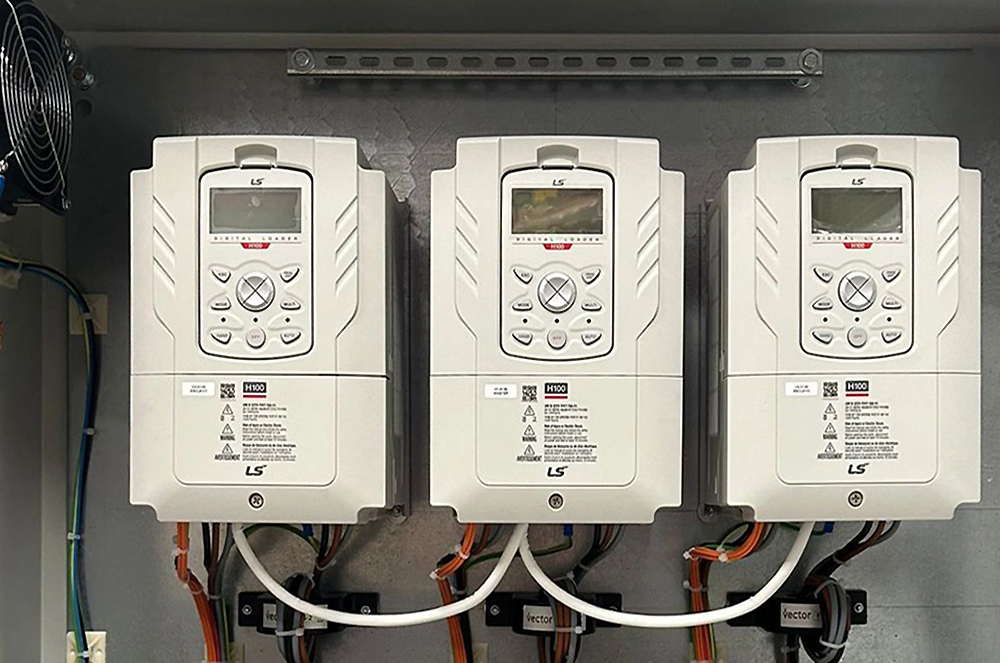
Discover the effects of not installing an output filter on a frequency inverter in the following video of the experiment conducted by Francesc Fornieles, product manager of Power Quality at Vector Energy. We explore the results without the filter at two different cable lengths: 100 meters and 200 meters. Observe how the PWM output peaks are affected under these conditions and how to mitigate them with dV/dt filters and a sinusoidal filter.
You will see how these problems are solved by installing two essential filters: the dv/dt output filter for frequency inverters, model DVT, and the sinusoidal output filter for frequency inverters, model SNF. With the DVT filter, the output peaks of the PWM are limited, while with the SNF filter a smooth and controlled sinusoidal waveform is achieved.
When the output of a frequency inverter with pulse-width modulation (PWM) is not filtered, several undesirable effects can occur:
Electromagnetic interference (EMI): PWM can generate rapid and abrupt voltage spikes, which can cause electromagnetic interference in other nearby electrical equipment, affecting its operation and accuracy.
High-frequency currents: Without filtering, the high-frequency currents generated by the PWM can circulate through the electrical system, which can cause excessive heating of the components, damage to the cables, and other connected electronic devices.
Premature wear of the motors: The unfiltered waveform can cause unwanted voltages and currents in the motor, which can lead to premature wear, loss of efficiency, and possibly engine failure in the long term.
Power quality issues: Uncontrolled voltage and current spikes can contribute to power quality problems in the electrical grid, such as harmonics and waveform distortion, which can negatively affect other electrical equipment connected to the same network.
Want to learn more about how output filters can optimize your frequency inverters? Visit our website for detailed information and solutions tailored to your needs. Click here to discover how to improve the efficiency and performance of your electrical systems!
Watch video: Operation of the dvdt filter and the sinusoidal Vector Energy filter
Anglia Vector Energy is committed to helping you solve these problems and keep your engines running efficiently and reliably. If you have any questions or need more information, please do not hesitate to contact us.
Protect your investment and ensure the proper operation of your electric motors!
















 Articles