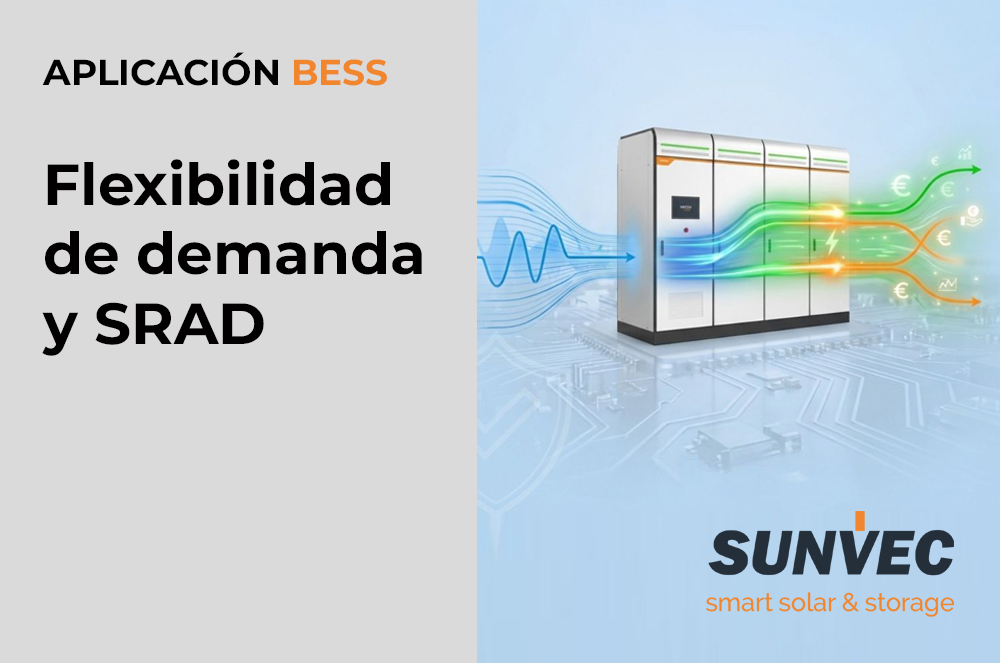
Demand flexibility and SRAD: new opportunities for the industry with BESS
The energy transition is changing the way companies consume electricity. It is no longer just about using energy efficiently, but also about being able to adapt consumption to the needs of the electrical system. This ability to temporarily modify demand is known as demand flexibility and can become a valuable resource for industrial and commercial facilities.
A battery-powered energy storage system (BESS) facilitates this flexibility because it allows for a partial decoupling of the moment when energy is taken from the grid from the moment when it is used. The battery can be charged when conditions are more favorable and discharged when it is necessary to reduce grid consumption, without having to stop essential productive processes.
How does a BESS contribute to flexibility?
When the company's electrical system or energy strategy requires a reduction in demand, the BESS supplies part of the power the installation needs. From the grid's perspective, consumption decreases; from the industry's perspective, equipment can continue to operate more normally.
This response can be programmed or activated in response to an external signal. An energy management system monitors consumption, battery charge status, and operational requirements to decide when to charge, discharge, or reserve capacity.
The role of the BESS in the SRAD
In Spain, the Active Demand Response Service (SRAD) is a balancing mechanism managed by Red Eléctrica that allows demand to contribute to system security through spot reductions in power. It is a voluntary and remunerated service, subject to requirements regarding activation, availability, measurement, communication, and minimum power, which can also be achieved through aggregation.
In this context, the BESS can reduce the energy drawn from the grid while keeping certain loads powered. This expands a company’s response capacity and prevents the entire reduction from having to come from a direct shutdown of processes. The actual participation will depend on the applicable regulations, the operating strategy, and the authorization of the consumer or their representative.
Benefits for industrial and commercial companies
· Greater control over demand: the company can adapt its exchange with the network without necessarily transferring all the impact to production.
· New potential sources of income: The availability and activation can be rewarded when participating in mechanisms such as the SRAD.
· Better utilization of assets: A single BESS can combine flexibility with self-consumption, peak reduction, or energy arbitrage.
· Rapid and automated responseBatteries can modify their power in very short periods of time when the control system receives a command.
· Support for renewable integration: A more flexible demand facilitates the management of an electricity system with a high presence of variable generation.
Dimensioning and strategy
To take advantage of these opportunities, it is necessary to analyze the load curve, the modifiable power, the duration of possible activations, and the charging state to be reserved. Dedicating the entire battery to daily savings could leave it without power when the service is needed. Therefore, coordination through an EMS and a service stacking strategy is fundamental.
At Vector Energy, we design BESS solutions adapted to each client's processes and objectives. Smart management allows converting electrical demand into a flexible asset, improving the energy control of the installation and preparing it to participate in the new services of the system.
Learn more: sunvec.es/storage












 Articles