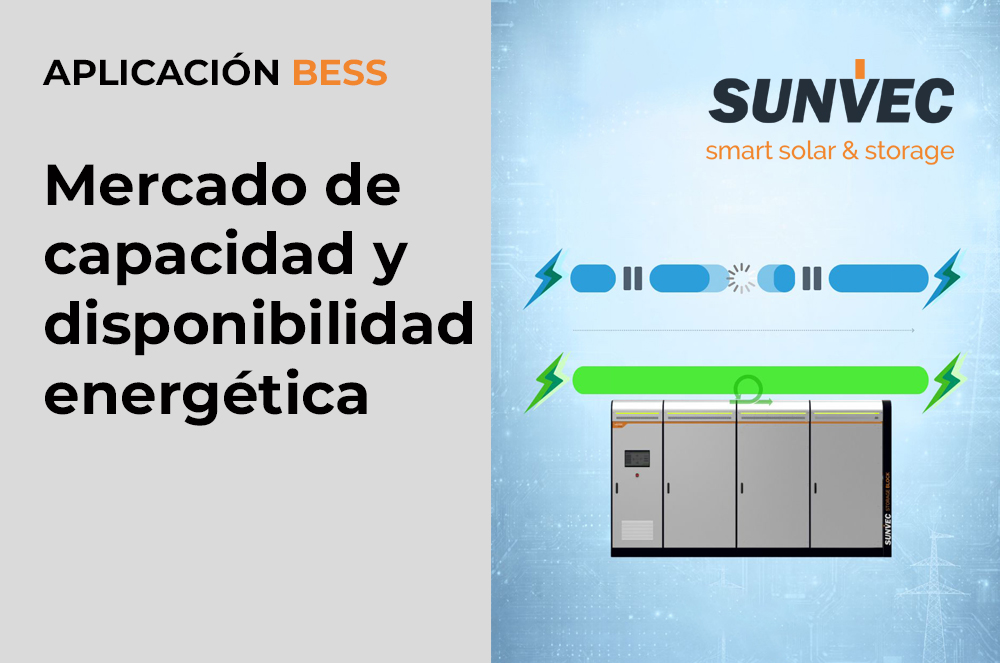
Market of energy capacity and availability: the role of BESS
An electricity system with a growing presence of renewable energies needs resources that can be available when generation is insufficient or demand reaches high levels. Capacity mechanisms or markets seek to ensure that firm power is available at times of greatest need, complementing the energy traded in the electricity market.
Unlike arbitration, where the value primarily comes from buying and using energy at different times, in a capacity mechanism the availability of the resource is recognized to respond when the system requires it. The specific design, products, auctions, and requirements depend on the current regulation.
Why can a BESS participate?
A battery can store energy beforehand and deliver it quickly and in a controlled manner. This capacity makes it a suitable resource for providing power during critical periods, provided that it meets the technical, measurement, communication, duration, and availability conditions established by the mechanism.
The BESS can operate individually or, when permitted, be integrated into an aggregated portfolio. For the industrial or commercial customer, this opens the possibility that an asset initially installed for self-consumption or peak reduction will also participate in future capacity schemes.
Availability versus energy
Distinction is important. Energy expresses how long a given power can be maintained; availability indicates whether that power will actually be ready when called upon. A BESS with high power but little energy capacity may not meet a requirement for long duration. Similarly, a battery occupied with other applications may not have the necessary state of charge.
The EMS must reserve capacity, plan for recharging, and coordinate the various services. It must also consider degradation, temperature, maintenance outages, and any testing or penalty obligations.
Potential benefits for customers
· Diversification of the value of the BESS: The availability can complement the savings obtained through other applications.
· Better use of assets: It allows to take advantage of power and capacity that would remain idle during certain periods.
· Preparation for new markets: Flexible architecture facilitates adaptation to future signals and energy products.
· Support for system security: Storage helps to cover periods of scarcity and to integrate renewable generation.
· Greater operational discipline: Continuous monitoring of the charging status and availability improves asset management.
A project that must include regulation
Participation is not automatic or guaranteed by installing a battery. It is necessary to check the applicable framework, prequalification, minimum power, required duration, communications, and economic regime. The projected revenues must be evaluated prudently and never substitute a complete technical-financial analysis.
It is also worth studying how the capacity market interacts with backup power. Preserving energy for the system and maintaining autonomy for an internal emergency can compete for the same capacity. A proper strategy defines priorities and safety margins.
At Vector Energy we develop modular and manageable BESS solutions, prepared to combine current and future applications. A design based on real availability enables storage to become a more versatile energy asset and aligned with the evolution of the electrical system.
Learn more: sunvec.es/storage















 Articles