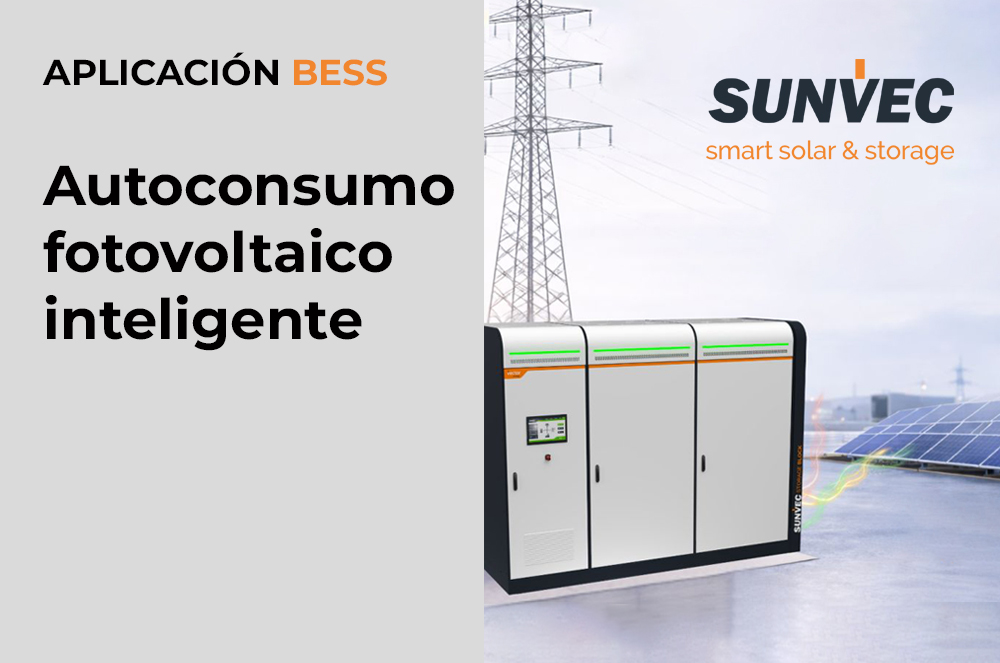
Smart self-consumption: how a photovoltaic installation improves by combining it with a BESS
A photovoltaic installation produces electricity only when there is solar radiation, but a company’s consumption profile does not always coincide with those hours. There may be surpluses at midday, and yet high demand at the start of the workday, during the afternoon shift, or after sunset. The addition of a BESS allows for managing this gap and turning conventional self-consumption into intelligent self-consumption.
The battery stores the solar energy that is not used immediately and delivers it when the installation needs it. In this way, a greater portion of photovoltaic production is consumed within the company itself, rather than being sent to the grid or wasted when there are export limitations.
Coordinated management of generation, consumption and battery
The energy management system monitors photovoltaic production, consumption, exchange with the grid, and the BESS’s charge status in real time. Based on this data, it decides whether it is advisable to directly feed the loads, store excess energy, discharge the battery, or reserve it for another application.
This management can incorporate weather and demand forecasts. If high solar production is expected, the system can create space in the battery in advance. If a peak in consumption is predicted in the afternoon, it can reserve the necessary energy to cover it.
Benefits for industrial and commercial facilities
· Higher rate of self-consumption: increases the proportion of photovoltaic energy used directly in the installation.
· Reduction of purchases online: The stored energy can cover consumption when solar production is insufficient.
· Lower outflow of surplus: It is especially useful when the compensation is limited or the installation works with zero overflow.
· Curve of power smoothed: The BESS compensates for rapid generation fluctuations caused by clouds and can limit peak demand.
· Greater energy autonomy: The company partially reduces its dependence on solar production schedules and the grid.
· Integration of other functions: The battery can combine self-consumption with arbitrage, peak shaving, flexibility, or backup, if it has been designed for that purpose.
Beyond storing surpluses
Smart self-consumption does not simply consist of charging the battery when there is excess energy. A too basic strategy can complete the charge in the early hours and leave the subsequent surpluses without storage capacity, or discharge them before the period of greatest value arrives.
Therefore, the EMS must order the various objectives according to the customer's priorities: maximizing solar energy, reducing the purchase cost, limiting the power output, maintaining an emergency reserve, or combining several functions. The programming can vary depending on the day of the week, the season, or the productive activity.
A data-based sizing
The installed photovoltaic power, the consumption curve, the volume and timing of the excess power, the connection point power, and the battery's usable capacity determine the result. A battery that is oversized may remain underutilized; a battery that is too small may not capture the available excess power.
At Vector Energy, we study generation and demand together to design BESS solutions tailored to each installation. The combination of photovoltaics, storage, and intelligent control allows for better utilization of renewable energy, cost optimization, and increased energy flexibility for the company.
Learn more: sunvec.es/storage








 Articles